Sugar Land, TX
 Click To Mail
Frequently Asked Questions
Thinking about enrolling but not sure where to begin? Find answers to frequently asked questions about age requirements, instruments, lesson formats, and more.
Young children can begin learning musical instruments naturally and intuitively. They should be able to recognize basic letters and numbers, listen attentively, and follow instructions.
- Piano: Suitable for ages 5 through adult.
- Guitar: Students with a child-sized guitar can start at ages 6 or 7. Younger children may begin on ukulele
- Voice: Ages 8 or 9 are ideal for starting voice lessons.
- Drums: Most students begin at age 6 or 7, when they can reach both the pedal and the cymbals. Younger children may come in for an evaluation.
- Strings: Violin students can start at ages 4 or 5. Viola and cello students typically begin at ages 6 or 7 due to instrument size.
String instruments such as guitars, violins, and cellos come in multiple sizes to fit growing students. Having the correct size helps children develop proper technique, and the teacher will guide you in choosing the right one. Piano keys do not vary in size, but footstools and adjustable chairs can help younger students play comfortably.
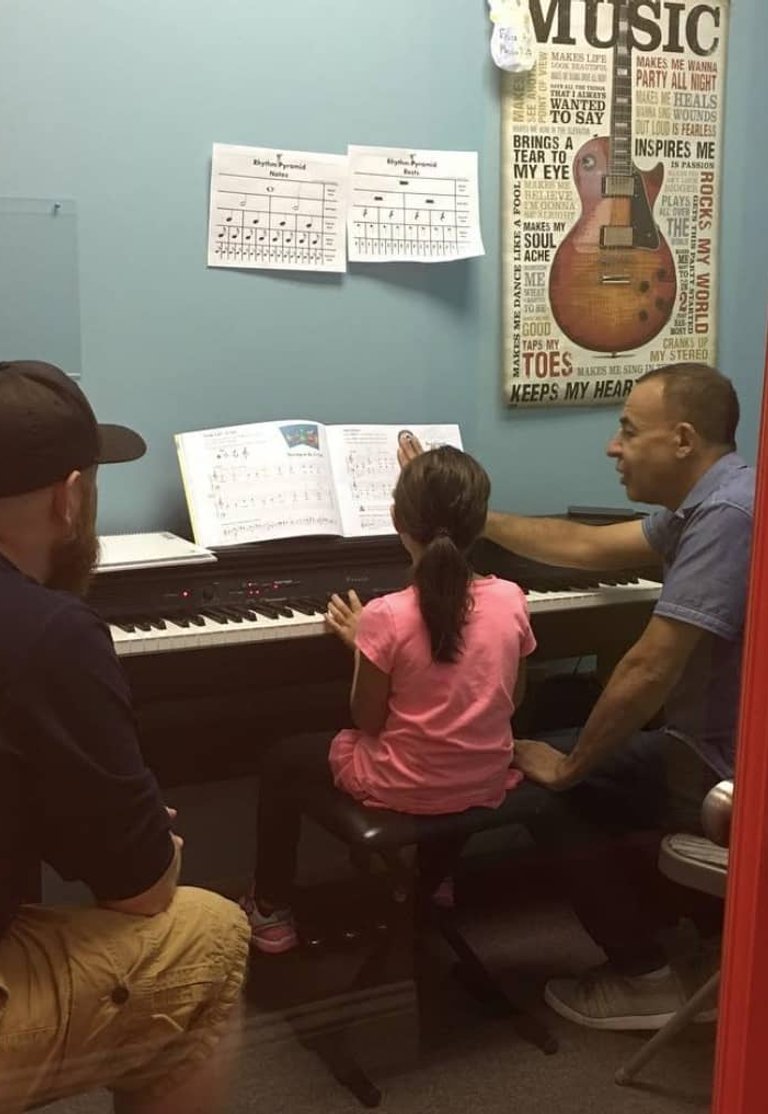
Yes. We have an open-door policy, and you may observe anytime. Some students focus better with a parent present, while others find it distracting. Your teacher will offer guidance once they know your child. All classrooms have viewing windows for easy monitoring.
Consistent, thoughtful practice is essential. Without it, progress slows and students may lose interest. For beginners, we suggest at least 15 minutes per day, 5 days a week. Short daily sessions are more effective than infrequent long ones. Developing a daily practice routine benefits both musical growth and overall discipline.
Parental involvement is key.
- Drop in on lessons occasionally.
- Supervise practice to ensure your child understands their weekly assignments.
- Offer rewards for consistent effort.
- Call practice sessions “play time” for younger children.
- Celebrate progress when they master a piece.
- Encourage them to perform for family members.
- Create a musical environment by playing music related to their instrument.
You are your child’s most important coach.
Temporary frustration is normal when learning a new skill. Instead of quitting, help your child work through the plateau. Many adults regret stopping lessons too soon. Parents can look ahead and see the long-term benefits, and sticking with the challenge often leads to the most rewarding outcomes.
Parental involvement is key.
- Electric guitars: have lighter string tension, making them easier to play.
- Acoustic guitars: don’t require an amplifier and can be played anywhere.
Most beginner amps include headphone jacks so volume isn’t an issue.
Contact the office so we can share feedback with the teacher and explore solutions. Sometimes a change of approach or new repertoire is enough. Other times, switching instruments is the right choice and can be done at any time.
Yes. Monitoring practice is extremely helpful. Parents may also observe lessons to understand how pieces should sound and what the correct technique looks like. Each student receives a weekly lesson plan. Parents can ask children to show that they have practiced each assigned item.
Yes. It is essential that students have something to practice on at home, and there are affordable options:
- Violins and cellos can be rented from H&H Music, Music & Arts, or Lisle Violin Shop. We can assist with rental arrangements.
- Drum students may begin with a drum pad and sticks.
- Piano purchases are available at Houston Piano Company and Fort Bend Music Center. An electric keyboard with 88 keys, a sustain pedal, and semi-weighted or weighted keys is also a good starting point.
No. Beginners can start with a practice pad, which is small and inexpensive. Child-sized drum sets are also available and very affordable. Even a basic set is often motivating for young students.
While piano is an excellent foundation, the best instrument is the one the student is excited about. If a child is not yet big enough for guitar, drums, or certain string instruments, starting on keyboard or ukulele is a good alternative until they grow. Interest in the chosen instrument is one of the strongest predictors of success.
All musical styles rely on the same foundations. Learning terminology and theory does not hinder creativity; it supports higher-level playing in any genre.
Yes. Music theory can be studied as a standalone subject for students preparing for college, auditions, or exams (MTAC, MTNA, Royal), or incorporated into regular lessons. For children, theory is introduced in a balanced way so it enhances their playing rather than overwhelming them. Private instruction allows teachers to tailor the depth of theory to each student’s needs and interests.
There is no fixed timeline. With consistent practice, beginners often reach a basic level of playing within a few months. More advanced skills naturally take longer. Most students continue long-term because they enjoy the process and want to keep improving.
We recommend practicing 4 to 5 days per week. For beginners, teachers often assign repetitions instead of time, such as “practice this scale twice a day” or “play this song five times a day.” Younger students require shorter sessions. Typically, beginners practice 20–30 minutes daily, ideally with some parental supervision. As students grow older, they are expected to take more responsibility. Private lessons allow teachers to adjust expectations based on each student’s schedule and goals.
Yes. A 30-minute lesson allows the teacher to review progress and provide a weekly plan. The majority of learning happens during home practice. As students advance, teachers may recommend moving to a 45-minute or 60-minute lesson.
Yes. All teachers are experienced professionals selected for both musical training and their ability to work well with students of all ages and skill levels. They hold university degrees and bring decades of teaching, performing, recording, and touring experience.
One advantage of studying at a full-service music school is flexibility. Most programs offer multiple teacher options. If a problem arises or you feel a different teaching style may be better, switching instructors is simple and always available.
Never. Adults often learn efficiently thanks to longer attention spans, focused practice habits, stronger reading comprehension, and internal motivation. Many adult students either return to lessons or take up a new instrument for the first time.
Your Question Not Listed Above
Still have questions? We're just a phone call away and ready to assist you.