Sugar Land, TX
 Click To Mail
Music Lessons For Special Needs in Sugar Land
At Groove Music School, we welcome children with special needs into private lessons, rock band classes, and appropriate performance opportunities. Our teachers are patient, experienced musicians who can adjust lesson pace, materials, communication, and practice expectations around the individual student. Call us or fill out our contact form to talk with us about your child.
We Welcome Special Needs Students at Groove Music School
Every student comes into a music lesson with a different set of strengths, interests, and challenges. For a student with special needs, we may adjust the pace of a lesson, spend more time on repetition, break a task into smaller steps, change how instructions are presented, or build more of the lesson around music that immediately captures the student's attention.
The goal is still to make music and develop real musical skills. We simply recognize that the best way to get there may look different from one student to another.
For guitar lessons in Sugar Land, piano lessons, singing instruction, our rock band program, and much more, please get in touch.
Music Lessons For Autistic Students
Autistic students can have very different learning preferences, so there is no single lesson format that fits everyone. Some students respond well to a predictable routine, clear instructions, repetition, and a consistent order of activities. Others become especially engaged when lessons connect to a favorite instrument, artist, soundtrack, or musical style.
Depending on the student, a teacher might divide a piece into short sections, demonstrate a concept several different ways, use listening and imitation alongside written music, or spend extra time on a musical activity the student particularly enjoys. Students can study piano, drums, guitar, voice, strings, band instruments, and other areas offered at our school.
Music Lessons For Hearing and Vision Impaired Students
A hearing or vision impairment does not rule out serious musical study. It may change how a teacher communicates a concept or how a student accesses the music.
For a student with limited vision, that could include larger music, verbal explanations, memorization, tactile demonstrations, and more emphasis on listening. Blind students may also become deeply involved in playing by ear, improvisation, songwriting, and learning repertoire through repeated listening and teacher demonstration. A student interested in jazz, pop, blues, rock, worship music, or another contemporary style can develop chords, melodies, rhythm, and improvisational ideas without relying exclusively on printed notation.
Students with hearing impairment may use visual rhythm cues, written notation, physical pulse, instrument vibration, and other approaches that suit the individual. The exact lesson format depends on the student's communication needs, instrument, goals, and what works best for them.
Music Lessons For ADHD Students
Students with ADHD may benefit from lessons with variety, short-term goals, and frequent opportunities to do something active with the instrument. Rather than spending a long stretch on one exercise, a teacher might move between technique, a favorite song, rhythm work, ear training, and another short assignment.
We can also break home practice into specific tasks. "Play this scale twice," "practice these four measures," or "work through this chord change five times" may be more useful than simply assigning a broad amount of practice time.
Drums, piano, guitar, voice, strings, and band instruments all give students immediate feedback. They can hear whether a rhythm stayed steady, whether a note was in tune, or whether a chord change worked. That direct connection between action and sound can make lessons particularly engaging.
Other Special Needs
We also welcome students with learning differences, developmental disabilities, physical limitations, communication needs, and other circumstances that may call for a more individualized approach.
Parents know a great deal about how their child learns. We encourage families to talk with us about what has worked well in school, at home, or in other activities. That information can help the teacher make better choices about pacing, instructions, repertoire, practice assignments, and lesson structure.
Special Needs Do Not Prohibit Music-Making at a High Level
Accommodations do not have to mean watered-down music lessons. A student may need a different route into a concept while still working on technique, repertoire, theory, improvisation, ensemble skills, and performance.
Some students may want music simply as an enjoyable weekly activity. Others may become serious players, singers, songwriters, or performers. We allow the student's ability and goals to guide that progression rather than assuming in advance how far they can go.
Learn Musical Fundamentals
Our teachers can work on the same musical fundamentals that appear throughout our other private lessons. Depending on the instrument, that may include rhythm, note reading, ear training, pitch, scales, chords, articulation, phrasing, dynamics, posture, tone production, and instrument-specific technique.
The teaching method can change when needed. One student may understand a rhythm best after seeing it written out. Another may need to clap it, hear it several times, or play it along with the teacher. A student learning chords might benefit from a visual diagram, repeated demonstration, or simply hearing how the harmony changes from one chord to the next.
We can also adjust practice assignments. Shorter sessions, repeated musical patterns, recordings, or a small number of clearly defined tasks may work better for some students than a traditional practice routine.
Learn Improvisation and Popular Genres
Reading traditional music is only one part of musicianship. Students can also explore improvisation, songwriting, playing by ear, and contemporary styles such as rock, pop, country, jazz, blues, worship music, and film or game music.
A piano student might learn a chord progression and improvise a melody over it. A drummer may build variations around a basic groove. A guitarist or bassist might learn a favorite song by ear and then experiment with fills or accompaniment patterns. A singer may work on phrasing, songwriting, or interpreting a familiar song in a personal way.
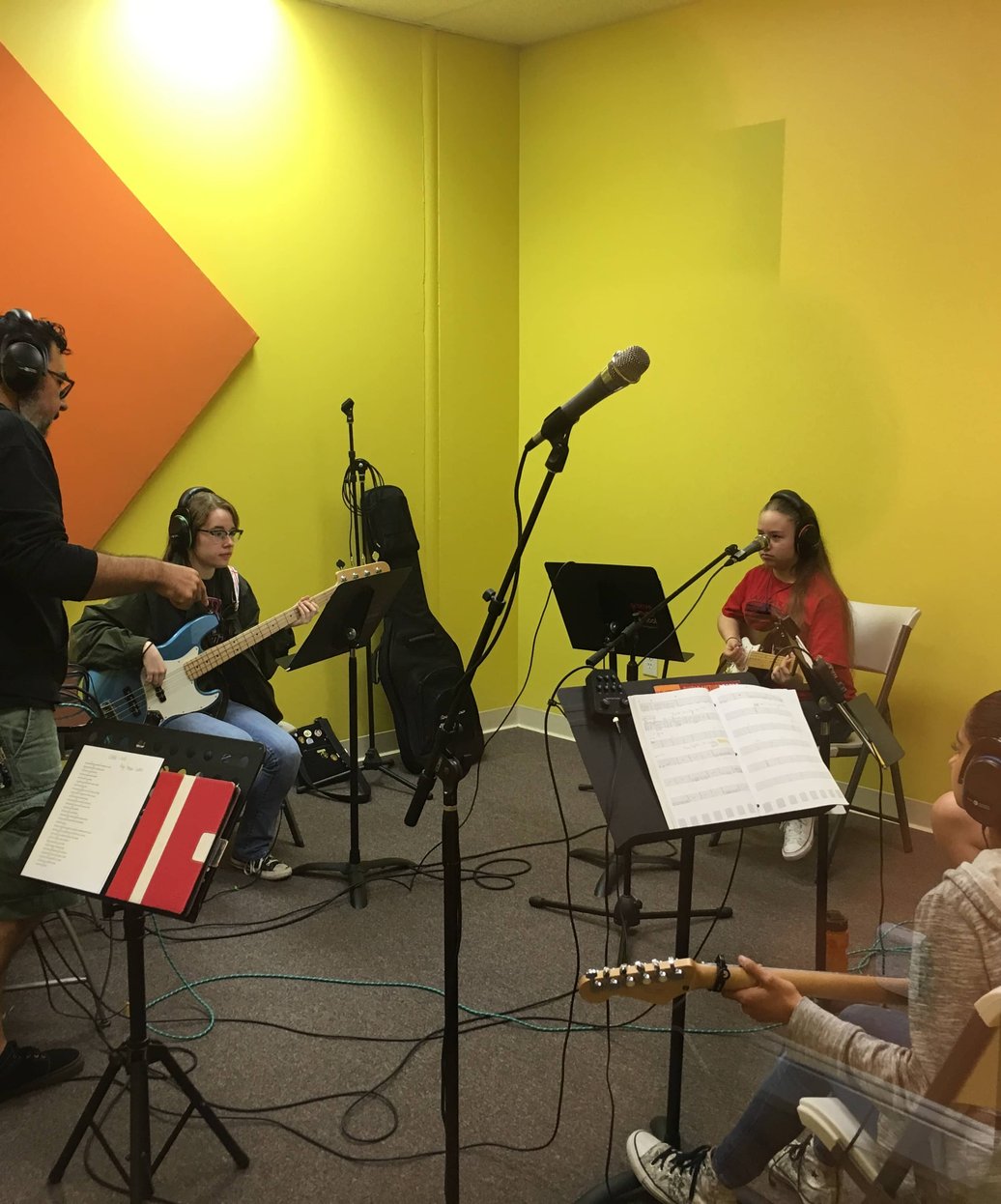
Students who are ready for an ensemble setting may also have opportunities to participate in our rock band program with appropriately matched peers. We offer performance opportunities during the year as well, so students who want to take the stage can work toward a real musical goal.
Contact Us About Special Needs Music Lessons in Sugar Land
If your child loves music, we would be glad to talk about how lessons might work for them. Groove Music School offers private instruction across a wide range of instruments, along with rock band classes and performance opportunities for students who are ready for them. Call us or fill out our contact form today and tell us a little about your child, their interests, and how they learn best.